
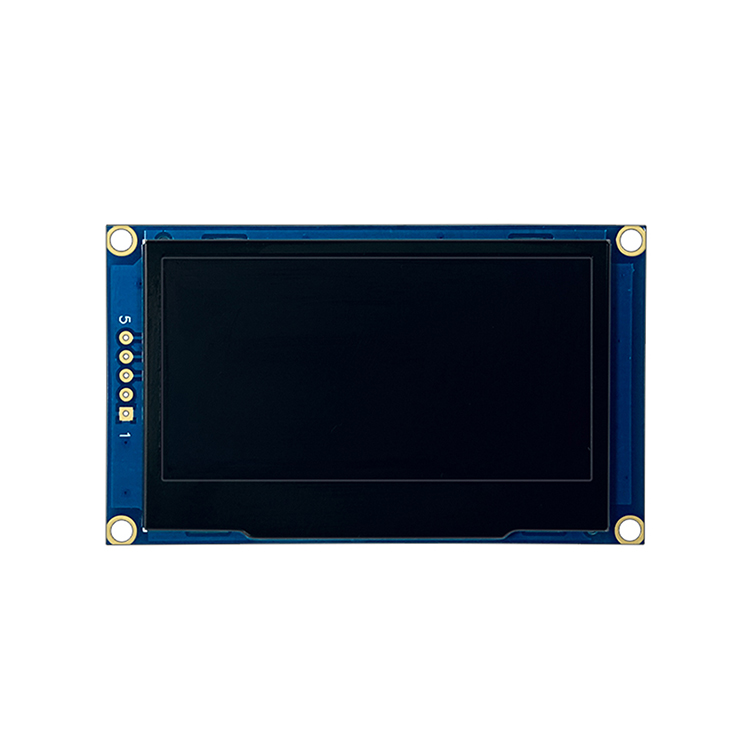
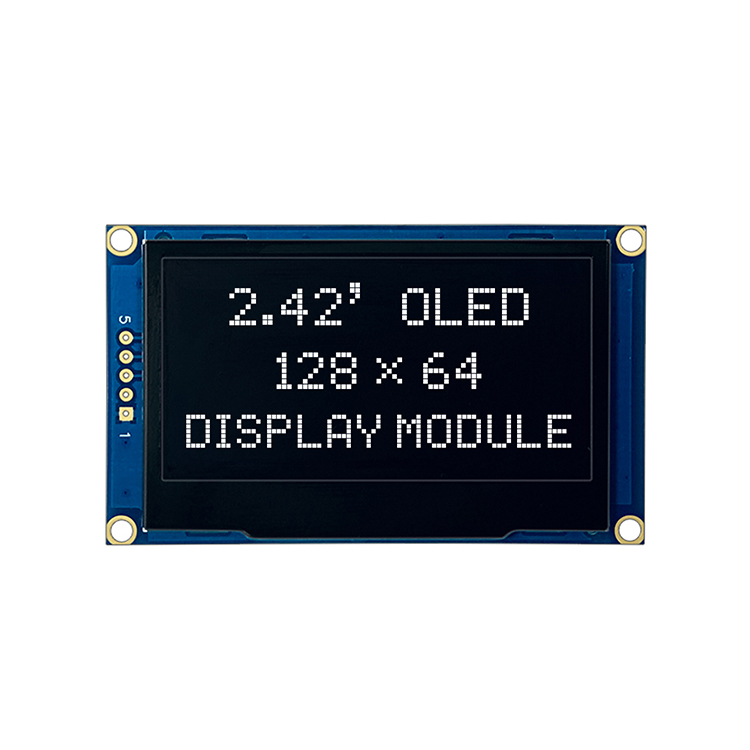
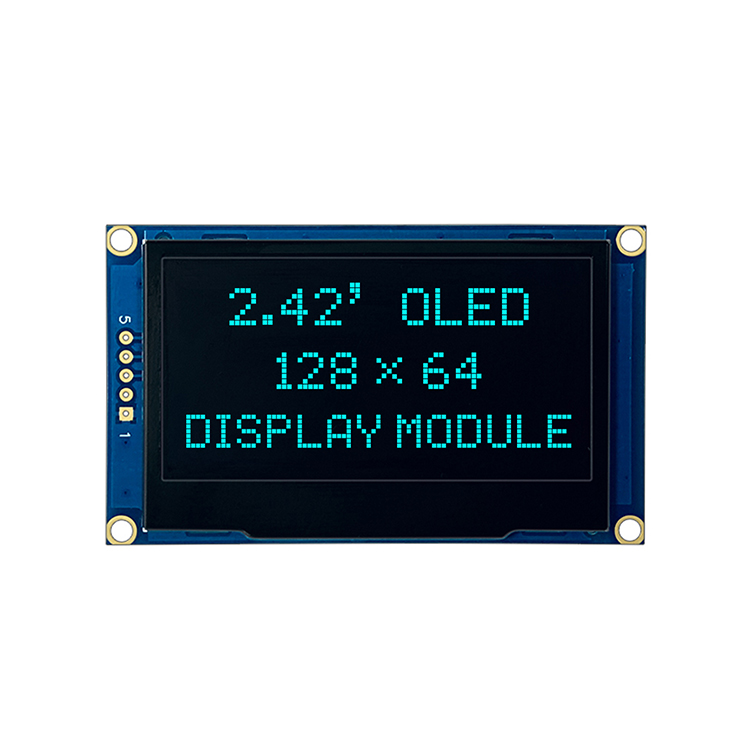
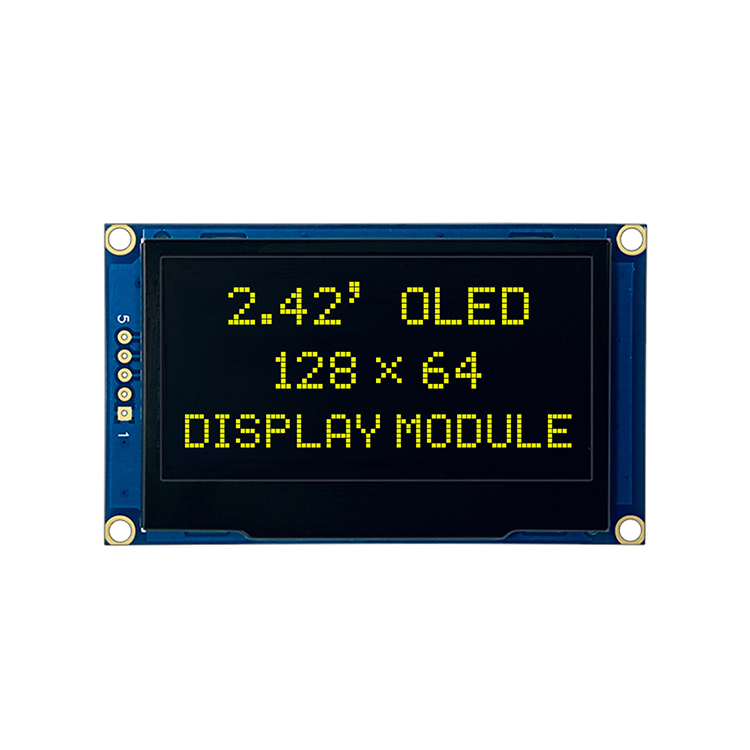
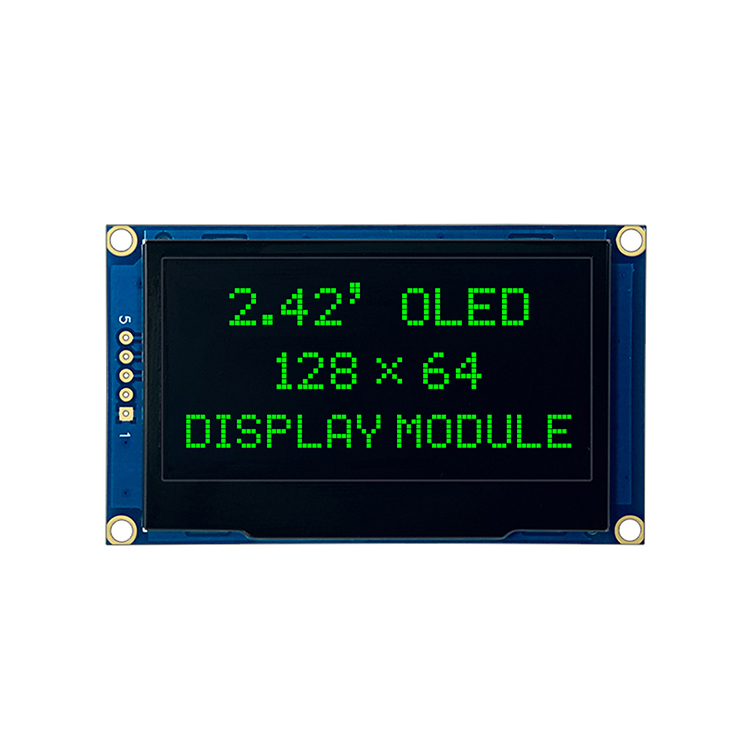
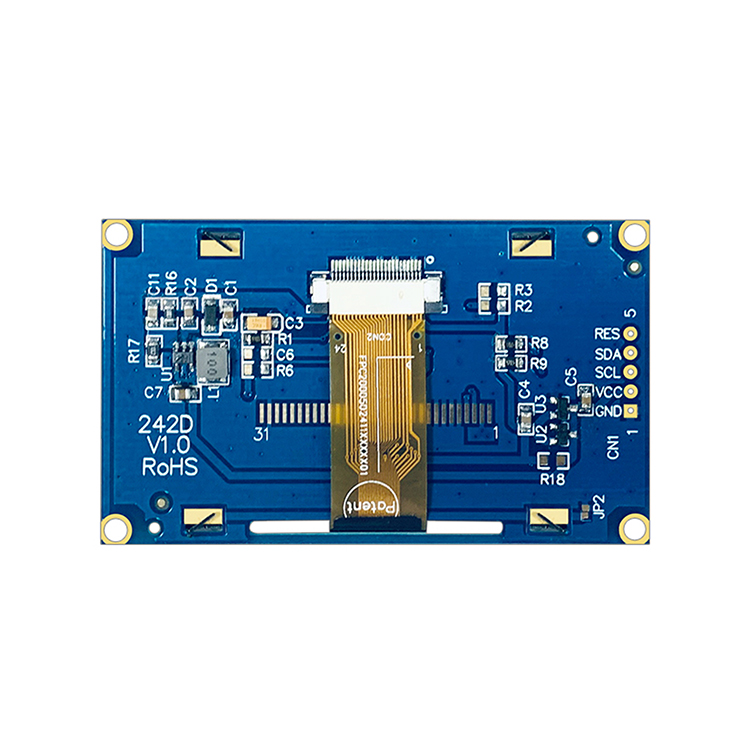
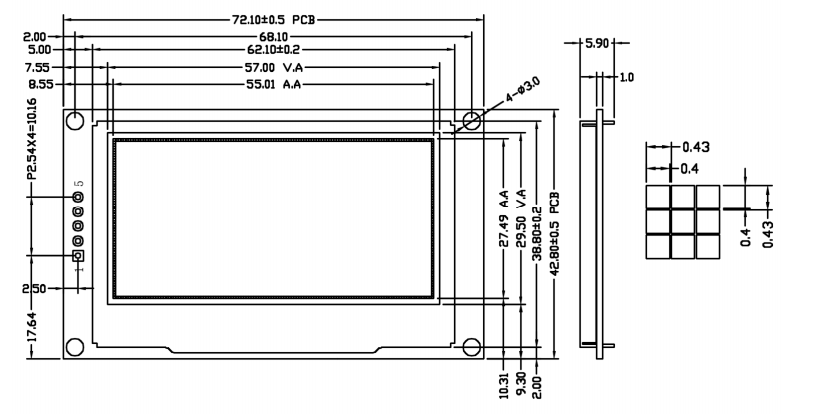
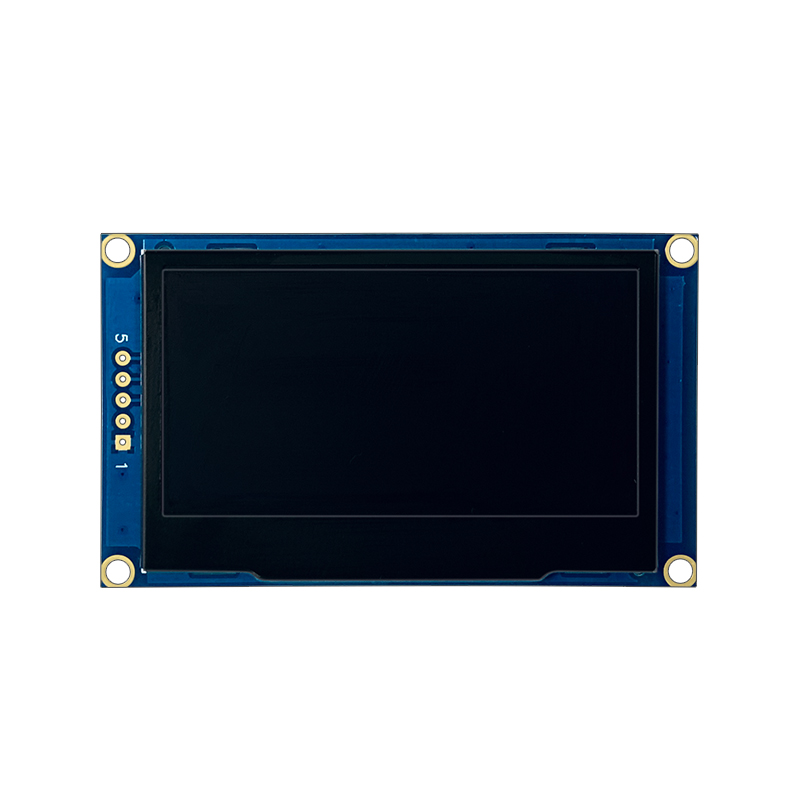
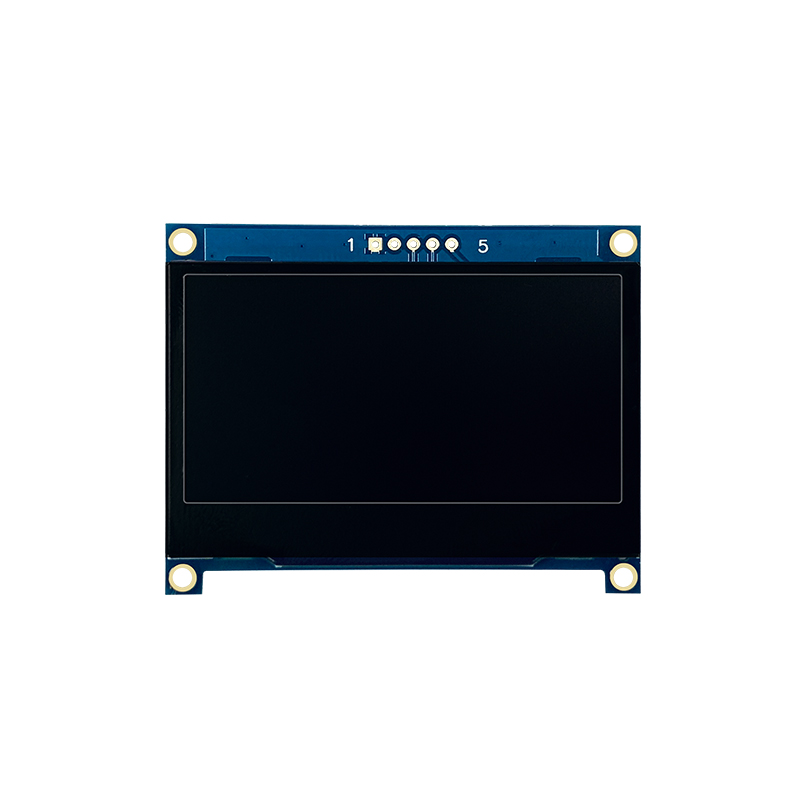
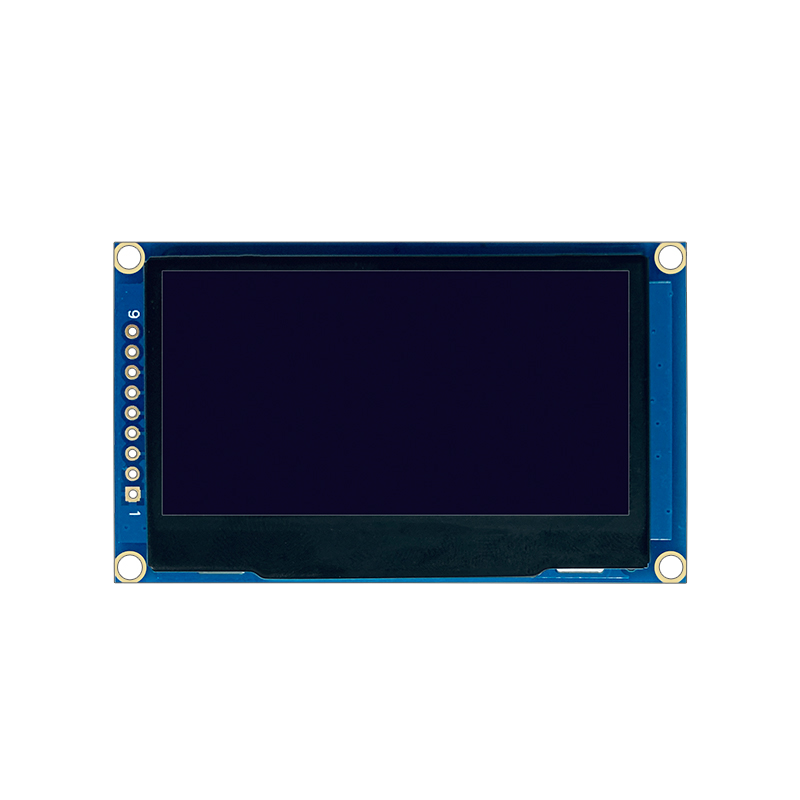
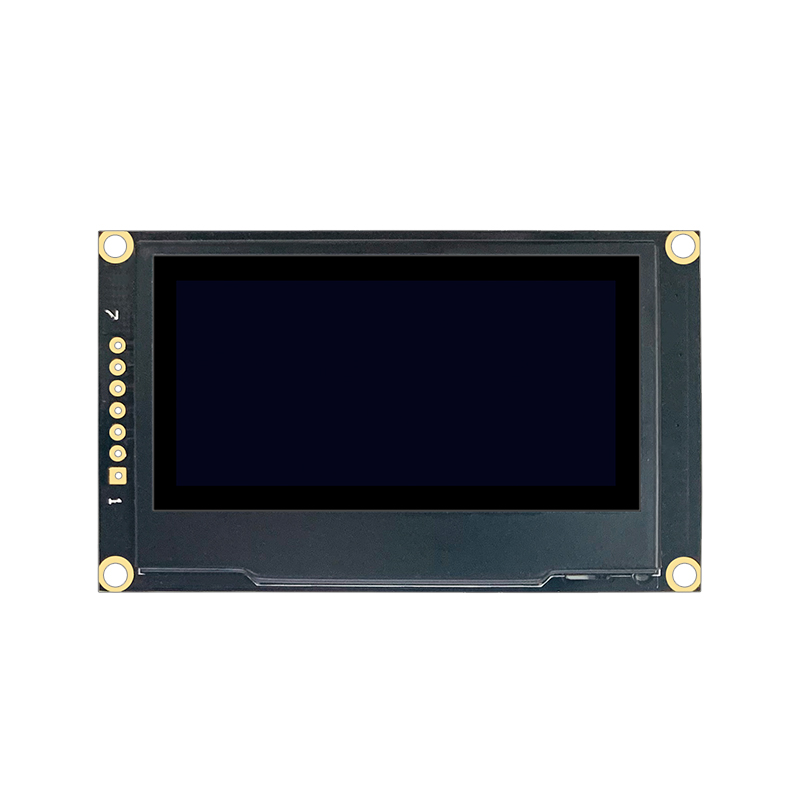
The 2.42-inch OLED display module is a passive-matrix graphical display featuring a 128×64 dot resolution and driven by the SSD1305 controller IC. It adopts a monochrome emission scheme with multiple color options such as yellow, white, and green, and supports an IIC interface for simplified system integration. With a compact outline of 72.1 × 42.8 × 5.9 mm and an effective display area of 55.01 × 27.49 mm, the module operates reliably across a wide temperature range from -40°C to 80°C, making it suitable for industrial and embedded applications.
Parameter
Specification
Display Mode
Passive Matrix
Display Format
128 × 64 dots
Display Size
2.42 inch
Resolution
128 × 64
Color Options
Monochrome (Yellow / White / Green / White)
Drive Duty
1/64 Duty
Viewing Direction
All-angle
Driver IC
SSD1309
Interface
IIC Port
Outline Dimensions
72.1 × 42.8 × 5.9 mm
Viewing Area
57.01 × 29.5 mm
Effective Area
55.01 × 27.49 mm
Pixel Size
0.39 × 0.39 mm
Pixel Pitch
0.43 × 0.43 mm
Pin Count
20 Pins
Operating Temperature
-40°C to 80°C
Storage Temperature
-40°C to 85°C
From an engineering standpoint, this OLED module is constructed on a passive matrix addressing scheme, utilizing a 1/64 duty cycle to balance luminance performance and power consumption. The SSD1309 driver IC, as an enhanced alternative to the SSD1305, introduces improved display stability, optimized contrast control, and broader compatibility with modern microcontroller platforms.
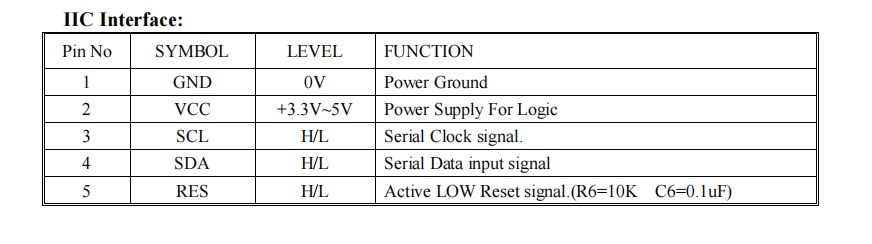
The integration of an IIC (Inter-Integrated Circuit) interface significantly reduces pin count requirements, enabling streamlined PCB layouts and efficient communication in resource-constrained systems. This design choice is particularly advantageous in compact embedded devices where space and routing simplicity are critical.
The display offers a viewing area of 57.01 × 29.5 mm, with an effective luminous region slightly reduced to ensure uniform brightness and edge consistency. Each pixel measures 0.39 × 0.39 mm with a pitch of 0.43 mm, delivering clear graphical representation while maintaining a balanced pixel density for readability.
Mechanically, the module is engineered with a 20-pin configuration, facilitating stable electrical connection and ease of integration. Its robust structural design supports operation in harsh environmental conditions, aligning with industrial-grade requirements.
The module demonstrates stable electrical characteristics across a broad temperature spectrum. Its passive matrix operation ensures low power consumption, while the SSD1309 driver enhances grayscale control and display uniformity.
Application Scope and Integration Advantages
Owing to its balanced optical performance and simplified interface design, the 2.42-inch OLED module is well suited for a variety of applications, including industrial control panels, portable instrumentation, medical devices, and consumer electronics.
The IIC interface allows seamless communication with widely used microcontrollers such as STM32, Arduino, and ESP series devices. Its low power requirements make it particularly attractive for battery-powered systems. Additionally, the wide viewing angle and high contrast ratio inherent to OLED technology ensure consistent readability under diverse lighting conditions.
In practical deployments, the SSD1309 driver enables flexible display control, including partial updates and contrast tuning, which contributes to improved user interface responsiveness and energy efficiency.
System Integration Considerations
Contact: David
Phone: +8618665976986
Tel: +8675521563288
Email: [email protected]
Add: 305 Room A Buiding Huafeng International Robot Industrial Park Xixiang Bao'an
 hicenda
 David Dang