Get Fast Support From Our Sales Team
Get Fast Support From Our Sales Team
Need product information, quotation, samples, or delivery details? Our sales specialists will help you select the right TFT, OLED, AMOLED, or custom display solution.

Screen specifications misdirect. When a supplier quotes peak brightness without telling me how much of the panel was lit, how long it held that output, or what the cover glass does to representations, I still can not inform whether a specialist will check out the alarm at twelve noon. What excellent is a fantastic test spot if the actual interface rinses?
I start with what individuals require to review, where they’ll review it, and how long the exact same photo will certainly remain on screen. Those three solutions can narrow the shortlist before anybody opens up a datasheet.
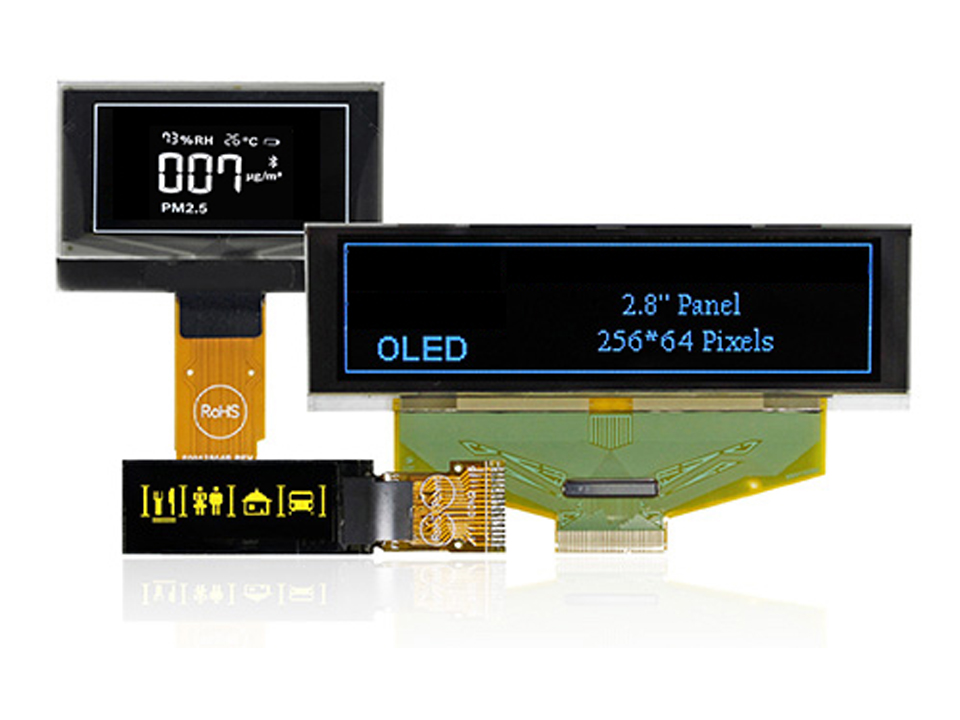
OLED means natural light-emitting diode. When current travel through slim organic semiconductor layers, the pixels produce their very own light. A pixel can turn off to produce black, and the panel needs no different backlight. In a dark environment, that offers OLED particularly solid contrast around small information, such as white message on a black control panel.
The materials issue. In 1987, Kodak scientists Ching W. Flavor and Steven A. VanSlyke utilized Alq six (C ₂₇ H ₁₈ AlN THREE O ₃) as the light-emitting layer in an early OLED diode. For customers, the sensible question is how the ended up component’s materials, drive setups, and thermal style affect brightness and uniformity in time.
PMOLED, or passive-matrix OLED, checks the screen one row at once. As the row count climbs, each row obtains a smaller sized share of the drive time, making brightness tougher to preserve. I ‘d begin below for a compact monochrome readout with a couple of symbols, a measurement, or a brief status message.
AMOLED, or active-matrix OLED, makes use of thin-film transistor circuits to keep pixel drive in between refreshes. That design scales better to higher resolutions and matches user interfaces with full-color graphics, smooth scrolling, or video clip. For a battery-powered item, I ‘d determine existing on the screens individuals see usually. A dark status display and a bright setup web page can put really different tons on the very same component.
I ‘d price a character LCD initially for a tool that invests its shift revealing a setpoint and an alarm system code. A one-line user interface can use the HL1601A 16 × 1 character LCD with a blue history. If operators need a 2nd line for units or standing, compare it with the HL2002A 20 × 2 personality LCD with a 4/8-bit user interface.
For menus and simple charts on an existing parallel host, use the HL12864D 128 × 64 monochrome graphic LCD as a baseline. If tags and stories complete for horizontal space, prototype the same layout on the HL19264A 192 × 64 visuals LCD with an 8-bit parallel user interface.
| Present kind | Ideal fit | What I would certainly validate on an example |
|---|---|---|
| PMOLED | Tiny monochrome readouts, icons, and short tags | Readability at the needed brightness and present with the actual screen layout |
| AMOLED | High-resolution shade user interfaces, scrolling, and video clip | Continual illumination, host transmission capacity, and harmony after static-content exposure |
| Character LCD | Fixed-format readings, counters, and standing codes | Personality capacity, watching instructions, and comparison in the unit |
| Graphic LCD | Grayscale menus, signs, and fundamental stories | Pixel design, controller compatibility, and readability under site illumination |
An OLED display screen is a display whose pixels produce light when electric present passes through natural semiconductor layers, permitting each pixel to be regulated separately and switched off for deep blacks, a layout that gets rid of the separate backlight made use of in a common transmissive LCD.
AMOLED and PMOLED are two methods of driving OLED pixels, with AMOLED utilizing thin-film transistor circuits to keep each pixel’s drive between refreshes and PMOLED scanning rows in sequence, a plan that works well for tiny readouts but ends up being harder to scale as the row matter rises.
Selecting an OLED display dimension and resolution indicates matching the panel’s active location and pixel grid to the tiniest text, icons, or graphics customers must check out at the designated viewing distance, while checking that the module fits the enclosure and the host can drive the needed updates.
OLED burn-in is a permanent adjustment in screen uniformity caused by uneven aging of the light-emitting pixels, often looking like a faint outline of a logo design, toolbar, or standing bar that continuously occupied the very same placement, with danger affected by illumination, temperature, and the length of time the material remains dealt with.
Send Hicenda your room drawing, host interface, running temperature level array, and two screenshots from the intended interface. Consist of the brightest screen customers will see and the screen that remains visible longest. Request for 2 candidate components, their datasheets, and example rates, after that contrast them behind the same cover glass at the intended watching range.
Leave Your Comments