Get Fast Support From Our Sales Team
Get Fast Support From Our Sales Team
Need product information, quotation, samples, or delivery details? Our sales specialists will help you select the right TFT, OLED, AMOLED, or custom display solution.

An AMOLED display is a self-emissive screen. Every subpixel makes its own light and is switched by a thin-film transistor circuit built beneath it. This design is what makes AMOLED thin, gives it deep blacks and fast response, and explains why it leads in premium phones and wearables. Engineers and sourcing teams may be building handheld instruments, medical devices, portable monitors or embedded HMIs. For them, the question is rarely whether AMOLED looks good. They need to know four things about a specific module: whether it will survive the product’s duty cycle, connect cleanly to the chosen processor, stay available for the production run, and justify its cost over a TFT LCD. This guide covers how AMOLED works, where it beats the alternatives, and where it carries real risk. It also covers the datasheet parameters and RFQ details that decide whether an integration succeeds.
AMOLED stands for Active-Matrix Organic Light-Emitting Diode. “OLED” is the light source: thin organic layers that emit light when current flows through them. “Active matrix” is how each pixel is driven. OLED-Info’s AMOLED technology overview explains that every red, green and blue subpixel in an AMOLED has its own small circuit. Each circuit has at least two transistors and a storage capacitor. The capacitor holds the pixel’s data, so the pixel stays lit for the whole frame while other rows are written. The same source says almost all OLED displays in use today are AMOLED, from smartphones and smartwatches to laptops, monitors and TVs.
An AMOLED needs no backlight, so a pixel that is switched off emits no light. This explains three things: the deep black level, the high contrast in dim rooms, and the fact that power use depends on what the screen shows.
Buyers often see these terms used as if they meant the same thing, and that causes specification errors.
A typical AMOLED module is a stack of layers, and each one raises its own sourcing and integration questions:
The backplane material sets pixel density, power behavior, and which sizes a panel can reach at a sensible cost. OLED-Info describes three main types:
In an embedded product, you rarely get to choose the backplane. It still matters because it shows which product family the panel came from. That family affects variable refresh support, idle power and long-term availability.
The table below gives qualitative differences. Use it to build a shortlist, not in place of a module datasheet, because real performance varies with the panel, the driver and the operating conditions.
| Factor | AMOLED | TFT LCD (IPS) | PMOLED | Micro OLED |
|---|---|---|---|---|
| Light source | Each subpixel emits light | Shared LED backlight through liquid crystal | Each pixel emits light | Each subpixel emits light on silicon |
| Black level in a dark room | Pixels can switch fully off | Limited by backlight leakage | Pixels can switch off | Pixels can switch off |
| Power behavior | Rises with brightness and lit area | Set mainly by the backlight; changes little with content | Rises with lit pixels; inefficient for detailed content | Low per panel, but needs optics |
| Static-content risk | Permanent uneven aging (burn-in) possible | Temporary image retention possible; no emitter aging | Uneven aging possible | Uneven aging possible |
| Full-screen brightness | Often limited when most of the screen is bright | Depends on backlight design | Limited | Very high per area, viewed through optics |
| Thickness and form factor | Very thin; flexible and curved options | Thicker because of the backlight | Thin, small sizes | Sub-inch near-eye displays |
| Typical interfaces | MIPI DSI, eDP, SPI/QSPI on small panels | RGB, LVDS, MIPI, eDP, SPI | SPI, I²C, parallel | MIPI, often with a driver board |
| Supply profile | Often comes from consumer device programs | Wide industrial availability | Mature, small formats | Specialist suppliers |
| Best fit | Premium handhelds, wearables, dark UIs, thin devices | Static HMIs, sunlight-readable and long-lifecycle equipment | Simple low-cost status displays | XR headsets, viewfinders |
Only for some content. AMOLED power rises with the number of lit pixels and how bright they are. An LCD backlight draws about the same power whether the screen shows black or white.
A common mistake in AMOLED projects is to treat “lower power” and “infinite contrast” as fixed properties of the panel. Both depend on the application. Contrast measured in a dark room drops once room light reflects off the front of the display, and the power advantage depends on the UI design. If the product’s interface is bright and mostly static, the case for AMOLED has to rest on thinness, image quality or form factor, not battery life.
The display interface can also cut power for static images. The VESA announcement of Embedded DisplayPort version 1.5 describes panel self-refresh. With this feature, a static image is held in display memory while other parts of the system go into low-power standby. Check the datasheet to confirm whether a given module supports it.
OLED materials lose brightness as they run, and the colors don’t age at the same rate. A peer-reviewed review in The Journal of Physical Chemistry Letters on OLED stability and degradation mechanisms compares lifetimes at 1,000 cd/m². Red and green phosphorescent OLEDs reach LT50 values above 10⁵ hours, while blue fluorescent emitters reach just over 10⁴ hours. LT50 is the time until brightness falls to half its starting value. The review names this mismatch as a cause of uneven aging and color-balance change. These are lab figures for single devices, not ratings for any commercial panel. They still explain why AMOLED panels shift in color as well as dim.
Burn-in shows when some pixels age more than their neighbors. In equipment interfaces, the usual causes are fixed status bars, logos, white menu frames and crosshairs. A difference in brightness much smaller than the 50% behind LT50 can show against a uniform background. So a long LT50 figure does not mean a panel is free from burn-in.
Ways to reduce burn-in:
Ask suppliers how they define lifetime: the brightness criterion (for example LT50), the starting brightness, the test pattern and the temperature.
An AMOLED datasheet brightness figure only means something together with its test condition. Many panels limit current when a large area is bright. As a result, a full-white screen may not reach the brightness measured on a smaller white window. The polarizer also absorbs some light, and a glare surface adds reflections. Together, these make bright rooms and outdoor use harder for AMOLED than for a high-brightness LCD. Ask for brightness at the share of the screen you expect to be bright and at your operating temperature, and test samples under real lighting.
Many AMOLED panels lower brightness with pulse-width modulation (PWM), which switches the light on and off rapidly. DXOMARK’s analysis of display flicker is based on smartphone testing. It describes OLED PWM frequencies of roughly 50 Hz to 500 Hz, compared with about 1,000 Hz or higher for LCDs. Those figures describe phones, not every module. They are still reason to ask the supplier about the dimming method and PWM frequency when operators will watch the screen for long shifts or in dim rooms, such as clinics or control rooms.
AMOLED production capacity follows the consumer electronics market. OLED-Info reports a Counterpoint Research estimate that 894 million smartphone OLED panels shipped in 2025. Many small and mid-size AMOLED modules sold to equipment makers come from phone, tablet, laptop or wearable programs. When that program ends, the panel can reach end of life (EOL).
Industrial products often stay in production for five to ten years. Before freezing the design, request the supplier’s EOL notice policy, last-time-buy terms, and any pin-compatible alternatives.
Buyers usually compare resolution and diagonal size first, but those numbers rarely decide whether a module fits. Review these together:
The interface often decides the processor platform, board design and software schedule more than the panel does.
| Interface | Typical AMOLED use | Strengths | What to verify |
|---|---|---|---|
| MIPI DSI / DSI-2 | Phone-size to tablet-size panels | Few pins, low power, command and video modes | Host DSI support, lane count, per-lane data rate, initialization code, compression support |
| eDP | Laptop-size and larger panels | High resolution over few wires; power-saving features such as panel self-refresh | eDP version, lane count, link rate, power sequencing |
| SPI / QSPI | Small round or square wearable panels | Works with microcontrollers; simple wiring | Frame rate at full resolution, frame buffer location |
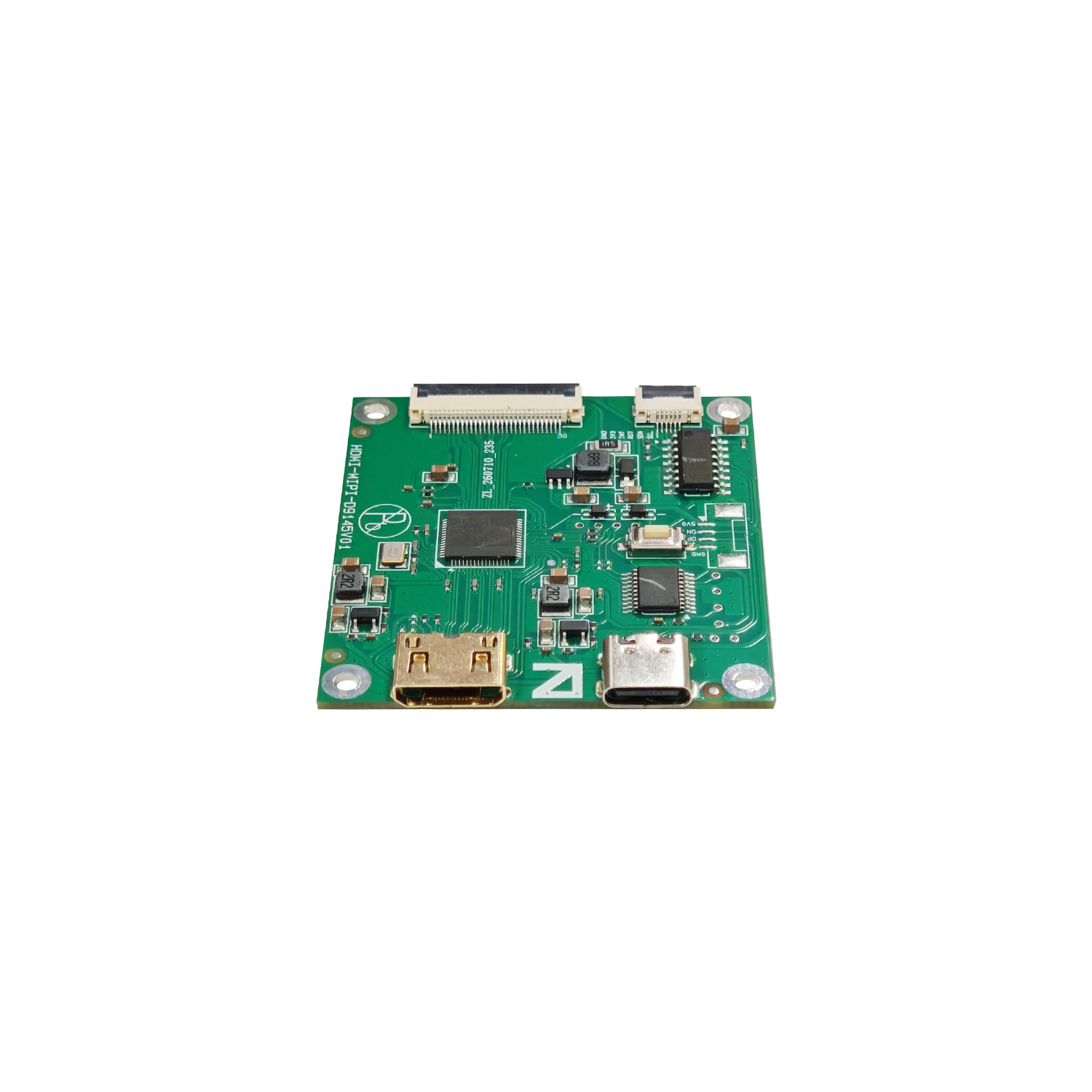
| HDMI or USB-C via bridge board | Prototypes, portable monitors, display assemblies | Plugs straight into PCs and single-board computers | Bridge IC, signal carried over USB-C, extra power, size and cost |
MIPI DSI is the default for small and mid-size AMOLEDs. The MIPI Alliance’s DSI-2 specification page lists smartphones, smartwatches, tablets, laptops and automotive among its use cases. It also notes that DSI-2 includes VESA Display Stream Compression (DSC).
As a rough sizing check, take a 1080 × 1920 panel at 60 Hz and 24 bits per pixel. It carries about 3.0 Gbps of pixel data, or about 0.75 Gbps per lane across four lanes, before blanking and protocol overhead. Confirm that your application processor can sustain that lane rate.
Larger panels often move to eDP. The 13.3-inch LTPS AMOLED module with an eDP interface is an example of a laptop-class format for instrument interfaces and embedded display assemblies. It has a 60 Hz refresh rate, an RGB stripe layout and 8-bit + 2 FRC color depth.
Teams that want to avoid MIPI integration altogether can shorten development with a complete display assembly that has a standard connector. The 6.5-inch AMOLED display with a USB Type-C interface is a housed assembly with 2240 × 1080 resolution and 500 cd/m² brightness. A USB-C connector alone does not tell you the video signal. Confirm whether the assembly expects DisplayPort Alternate Mode or another format, and check its power needs.
An RFQ that lists only size and resolution will attract quotes for panels that may not fit the host, enclosure or lifecycle. Include:
A short evaluation over the final interface, rather than a demo video loop, tells you more about AMOLED suitability than any datasheet comparison.
AMOLED is a type of OLED. OLED is the self-emitting organic material; AMOLED adds an active-matrix TFT backplane that drives each subpixel individually. Most OLED displays in phones, laptops, monitors and TVs today are AMOLED.
Lifetime depends on brightness, temperature and content. Suppliers usually define it as the hours until brightness falls to a set share of its starting value, such as LT50. Burn-in from static content can appear well before that point, so only compare lifetime figures measured under the same test conditions.
Yes, if the UI is designed for it: dark backgrounds, dimmed or moving static elements, screen timeouts and controlled brightness. For always-on interfaces with fixed bright elements, a TFT LCD is usually the lower-risk choice.
High-brightness IPS LCDs are usually easier to make readable in sunlight, because backlight output can be raised regardless of content. AMOLED brightness is often limited when large areas are bright, and the polarizer absorbs part of the light. Test both under real lighting.
Small and mid-size AMOLED modules mostly use MIPI DSI. Laptop-size panels commonly use eDP, and small wearable-style panels often use SPI or QSPI. HDMI and USB-C versions usually include a bridge board that converts the signal for the panel.
Cover glass, touch sensors, FPC routing and housings are commonly customized around an existing AMOLED panel. A new panel cell needs factory tooling and volumes that rarely make sense for industrial programs, so most projects start from a panel size that already exists.
Leave Your Comments