Erhalten Sie schnelle Unterstützung von Unser Vertriebsteam
Erhalten Sie schnelle Unterstützung von Unser Vertriebsteam
Benötigen Sie Produktinformationen, ein Angebot, Muster oder Angaben zur Lieferung? Unsere Vertriebsspezialisten helfen Ihnen gerne bei der Auswahl der richtigen TFT-, OLED-, AMOLED- oder maßgeschneiderten Display-Lösung.
Pixels require switches. In a normal TFT display, a grid of thin-film transistors establishes the voltage at each subpixel, while the liquid crystal layer, polarizers, and color filters regulate the backlight to create the image you see on a portable tool, control panel, or computer display. So why do item listings still ask buyers to choose in between “TFT” and “IPS”?
Due to the fact that the labels explain different parts of the screen. TFT describes the wiring that deals with the pixels. IPS describes how the liquid crystals move. A screen can be both. When I check out a spec sheet, I treat TFT as the beginning of the description. The valuable inquiries follow. Can you read it via the cover glass in straight sun? Can your processor revise it quick sufficient? Can you get the same modification when the following production run starts?
Exactly how does a TFT screen job?
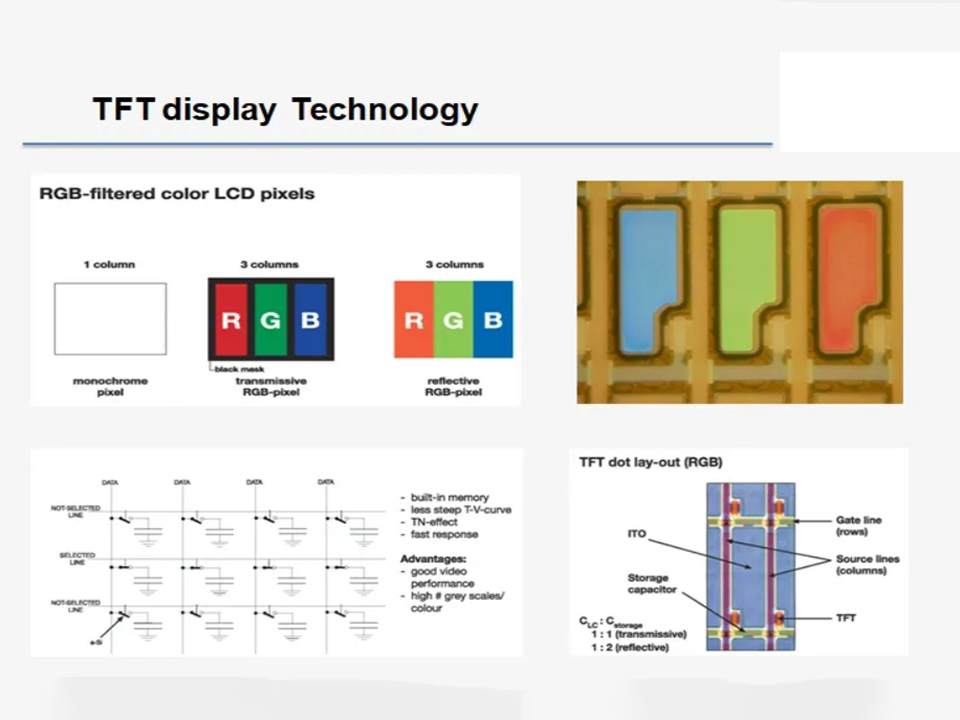
A Dünnschichttransistor is a tiny digital button made on the display substrate. In a common RGB TFT LCD, the red, green, and blue subpixels each have their very own switch. A gate vehicle driver chooses a row, and the column vehicle drivers use the voltages for that row’s subpixels. When the row is deselected, the subpixel’s capacitance, assisted by a storage space capacitor, assists hold the voltage till the following refresh.
That’s the energetic matrix. Each subpixel can maintain its programmed state while the vehicle drivers resolve other rows. A passive-matrix LCD uses shared row and column electrodes without a devoted switch at each subpixel. Active attending to offers developers a lot more control over grey levels and reduces the crosstalk that ends up being more challenging to manage as an easy matrix grows.
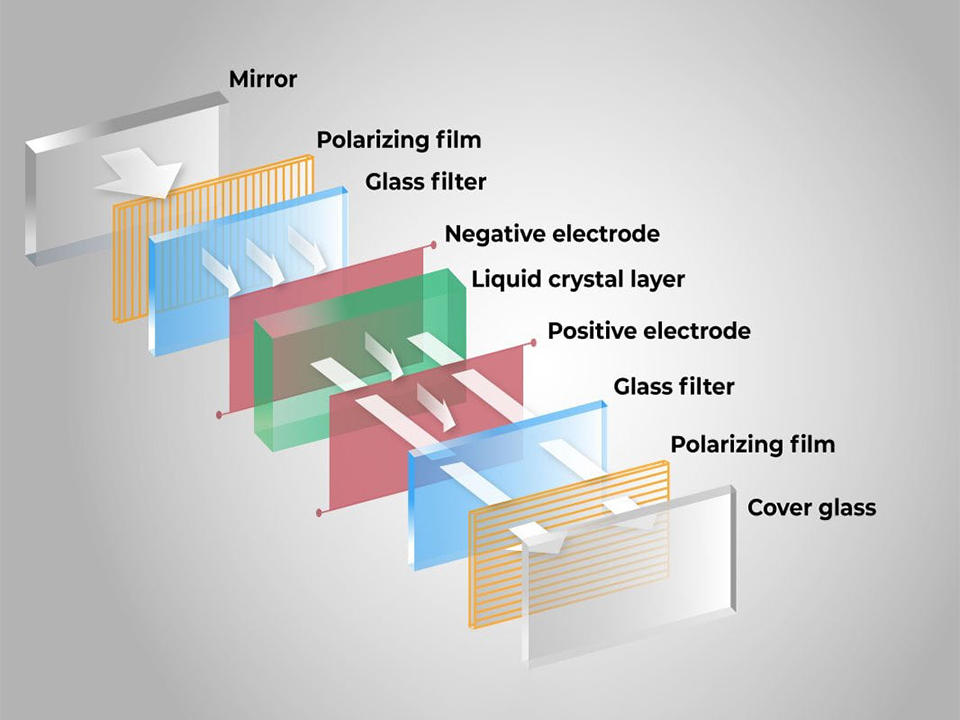
The backlight supplies the light. In a common transmissive color LCD, the voltage alters the orientation of the liquid crystals, which modifies how much light passes through the polarizers. Shade filters produce the red, green, and blue elements. The familiar LCD compromises adhere to from that optical stack. A dark pixel still needs to obstruct light from a backlight, and the stack absorbs several of the light you paid to produce.
TFT, IPS, and OLED define different things
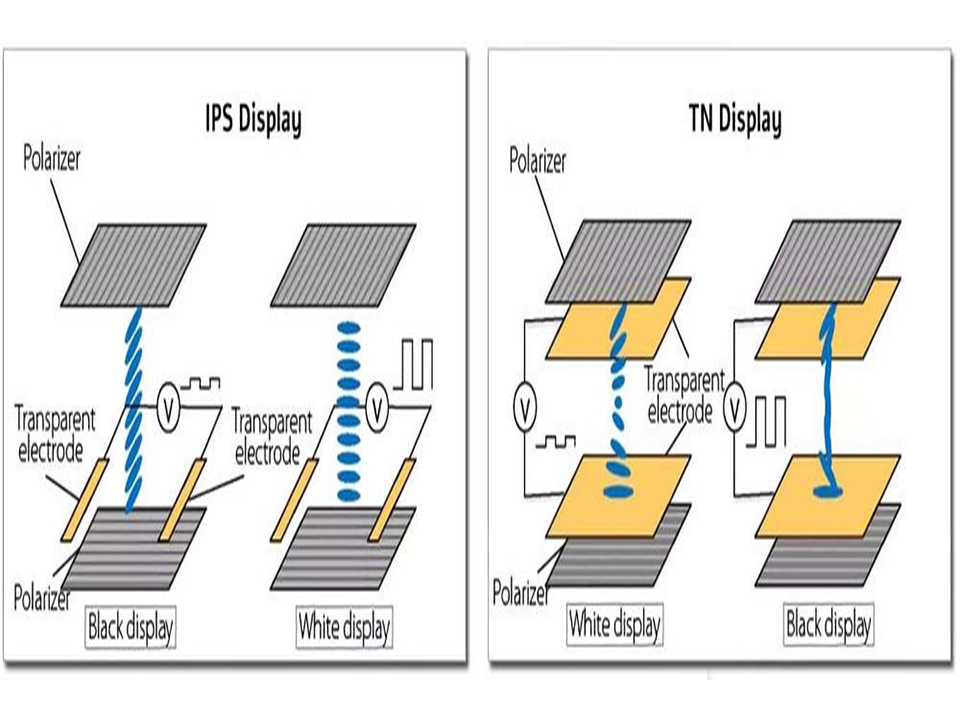
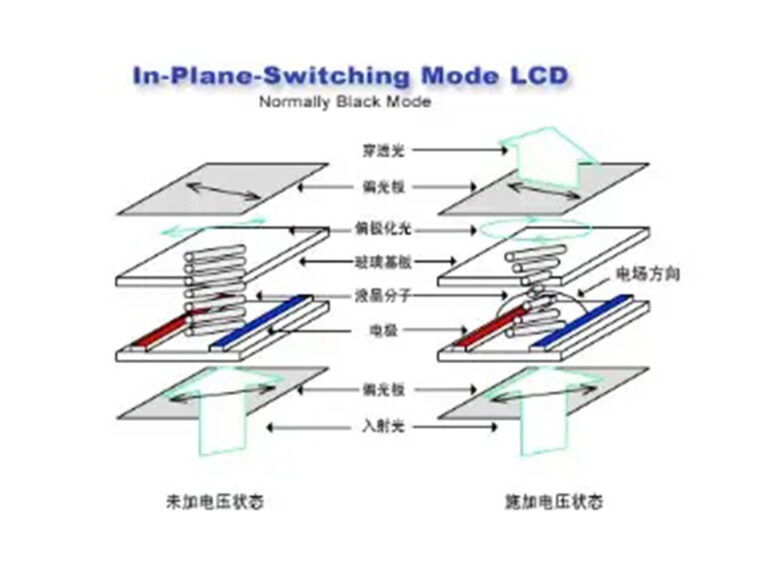
TFT recognizes the pixel-driving wiring. IPS, or in-plane switching, is an LCD setting in which the fluid crystals primarily revolve within the aircraft of the panel. It usually keeps shade and contrast much better when watched off-axis. TN stands for twisted nematic, and VA represent upright placement. Both are LCD settings that can likewise utilize a TFT backplane.
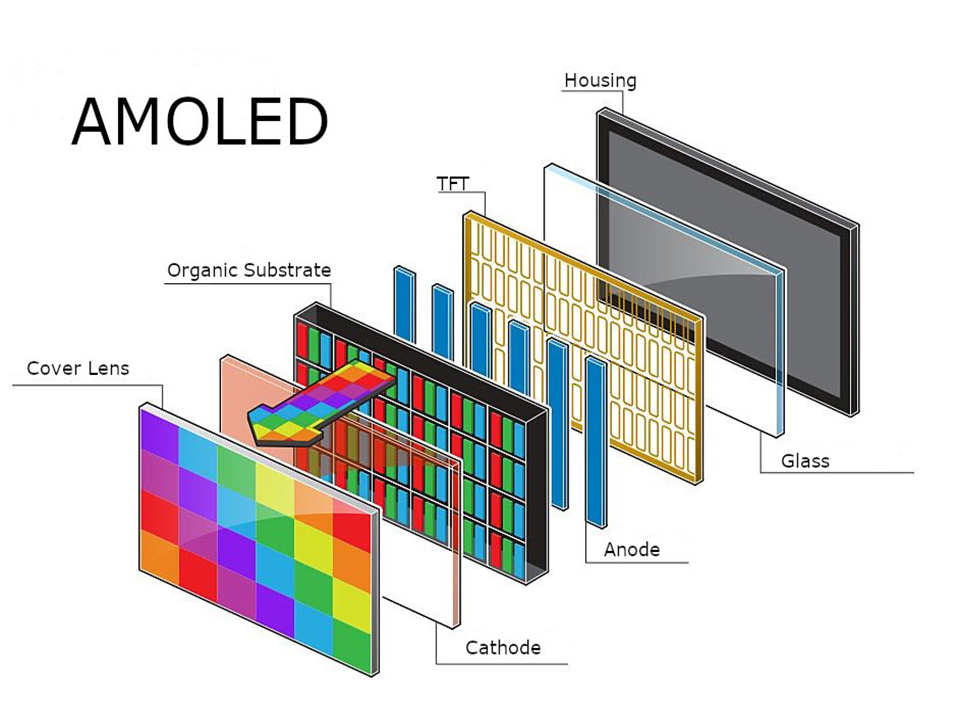
After that there’s AMOLED, or active-matrix natural light-emitting diode. Its organic subpixels give off light, and its active-matrix backplane makes use of thin-film transistors to manage them. When a brochure states “TFT vs. OLED,” reviewed it as shorthand for TFT LCD vs. OLED. If the distinction matters to the style, ask the supplier to recognize the panel kind and backplane clearly.
Backplane materials include one more layer. Amorphous silicon (a-Si) is widely made use of in TFT LCDs. Low-temperature polysilicon (LTPS) supplies higher carrier movement, while indium gallium zinc oxide (IGZO) is an oxide semiconductor made use of where low off-state leak can be useful. These names describe exactly how the electronics are made. To evaluate color, contrast, or exterior efficiency, I ‘d request the pertinent dimensions on the actual module.
What 3 2024 examples tell us about TFT LCD
Smartphones crossed a shipment limit. Omdia’s June 2024 Mobile phone Show Market Tracker tape-recorded 182 million AMOLED smartphone panels shipped in Q1 2024, up 39% year over year, versus 172 million TFT LCD panels, down 10%. Its full-year numbers, published in March 2025, placed AMOLED at 784 million and TFT LCD at 761 million. That was an initial for yearly smartphone panel shipments. It additionally left TFT LCD accounting for near half the volume in that market alone.
Apple marketed both modern technologies in the same tablet launch. In May 2024, the 11-inch iPad Air with M2 began at $599 in the United States and used a 500-nit, LED-backlit IPS LCD. Das 11-Zoll-iPad Pro mit M4 war ab $999 and made use of Tandem-OLED. Reuters covered the launches on May 7, and Apple released the exact starting prices and display specifications. The $400 gap covered 2 various items, consisting of different processors and base storage space abilities. It would be poor procurement mathematics to designate that space to the panel.
A diagnostic display screen shows what a severe LCD spec looks like. On November 27, 2024, the United State Food and Drug Administration provided a substantial-equivalence determination for EIZO’s RadiForce RX570 and RX570-AR under 510(k) K243221. The filing describes a 21.3-inch, 2,048 × 2,560 IPS TFT LCD mit 0.165 mm pixel pitch and factory-calibrated settings that consist of the DICOM Grayscale Criterion Display Feature. The RX570 has an anti-glare surface area therapy, while the RX570-AR makes use of an anti-reflection coating. The information worth borrowing for other screen projects is the self-control of specifying the seeing surface area and the calibration together with the pixel matter.
TFT screen benefits and negative aspects in a genuine enclosure
A TFT LCD makes sense for a color user interface that shows consistent details, approves periodic input, or needs to fit a particular mechanical opening. Think tool readouts, device controls, handheld meters, and round evaluates. An IPS version deserves evaluating if the operator routinely comes close to the screen from the side. A high-brightness version gains its area when the full assembly passes a readability test under the intended lighting.
I’m doubtful of “sunlight understandable” as a standalone spec. 1,500 nits means 1,500 cd/m two of luminance under the stated dimension conditions. Readability relies on just how much contrast survives after sunshine strikes the cover lens, touch layer, and panel. Representations can increase the noticeable black degree, and the backlight setting that looks good on an example may be also warm or power-hungry inside the final room. Request for the minimum luminosity, the examination problems, and the backlight existing at that setup. After that read the tiniest message the item really requires to reveal, at the angle people will certainly use it.
There are various other trade-offs. An LCD with a continuously lit backlight still draws backlight power when the user interface reveals a mainly black screen. Liquid crystal reaction can slow at low temperature levels, so an operating variety is only component of the response if a cold-start computer animation issues. And a screen that scans at 60 Hz can still reveal a slow user interface when the host can just send brand-new frameworks a portion as typically. Those are three various tests.
Just how to inform if a screen uses TFT technology
Beginnend mit dem panel design number and the supplier’s datasheet. Look for TFT-LCD, Aktivmatrix-LCD, oder AMLCD. Search for the LCD setting, chauffeur IC, interface, and backlight specification. A shop’s “LED display screen” description can mean an LED-backlit LCD, while “IPS” determines the liquid crystal mode. A photo gives you little to work with.
For a substitute, match the specific part number and revision against the connector pinout, power rails, mechanical drawing, user interface timing, and initialization series. Two modules can share an angled size, resolution, or even motorist IC while calling for various firmware or wiring. For touch designs, verify the touch controller, host user interface, coordinate mapping, and cover dimensions individually. I ‘d request for the illustration and initialization documents prior to devoting a PCB design.
Which TFT LCD component fits your layout?
For a compact handheld with mainly fixed displays, a serial display screen can keep the host connection simple. Hicenda’s thorough listing gives 172 × 320 for its 1.47-inch TFT LCD module with 4-line SPI. The public listing’s recap areas disagree with its thorough specs, so confirm both the resolution and controller IC against the existing datasheet before composing the chauffeur.
A rounded interface can increase the pixel budget plan rapidly. The HT018-XL12-1087 uses a 360 × 360 IPS panel, with an ST77916 chauffeur and SPI listed in the general public specs for the 1.8-inch round IPS TFT LCD. At 30 total updates per second and 16 transferred little bits per pixel, a 172 × 320 buffer requires about 26.4 Mb/s of pixel haul. A 360 × 360 barrier needs regarding 62.2 Mb/s under the exact same assumptions, before command expenses or still time. If the interface only alters a few values or a gauge needle, partial updates may make the difference.
For a brighter scale, the HT040WX-303-1007V1 is a 4-inch round TFT LCD rated at 1,500 nits and 720 × 720. The provider’s public requirements provide a four-lane MIPI panel interface and likewise define an HDMI chauffeur board. Verify whether your quote covers the bare panel or a board-equipped setting up. That identifies which host connection, power budget plan, and mechanical drawing apply.
Bei 3.4 inches and 800 × 800, the layout choice might come down to touch and product packaging. The HT034WX-B303-1006A-TB16 is provided with forecasted capacitive touch as a 3.4-inch round TFT LCD touch display screen. For a style with physical controls, Hicenda details the HT034WX-B303-002 as a 3.4-inch 800 × 800 MIPI TFT LCD without a touch panel. The public drawings and specs must be inspected by precise SKU. Both assemblies have various noted lays out despite sharing the exact same nominal size and resolution.
TFT LCD and AMOLED contrast
Gegenwartsform
Wo es hingehört
Was ist zu überprüfen?
TN-TFT-LCD
Fixed-view controls or designs where a particular panel satisfies the movement and expense targets
Off-axis contrast and shade, especially from the operator’s regular setting
IPS-TFT-LCD
Handheld instruments, shared display screens, and regulates seen from several angles
Minimum luminosity, representations via the finished cover, and backlight power
VA-TFT-LCD
Fixed-view applications that benefit from stronger native comparison
Dark-tone shifts and off-axis gamma change
AMOLED
Slim gadgets or user interfaces that take advantage of deep blacks and independently lit pixels
Power with depictive web content, sustained luminosity, and aging with consistent graphics
TFT screen FAQs
What is a TFT display screen?
A TFT screen is an active-matrix screen that makes use of thin-film transistors to control private picture aspects, and in ordinary item listings the term generally refers to a TFT LCD, where those transistors established the voltages that regulate just how much backlight goes through each subpixel. A TFT LCD can utilize IPS, TN, or VA fluid crystal modern technology.
Exactly how does a TFT display job?
A TFT LCD functions by picking a row of thin-film transistors, using a voltage to each subpixel on that particular row, and holding the resulting charge in between refreshes so the fluid crystal layer and polarizers can regulate just how much light gets to the viewer with each shade filter. The controller duplicates the process throughout the panel to construct the photo.
Ist IPS besser als TFT?
IPS is a fluid crystal changing mode utilized in lots of TFT LCDs, and it is usually the better fit when a screen requires to protect color and comparison for audiences taking a look at it from different angles, such as drivers approaching a control panel from the side. For a significant contrast, ask for off-axis dimensions for the details panels under consideration.
Exactly how can I inform if a display utilizes TFT technology?
One of the most reliable means to recognize a TFT screen is to look up its precise panel version and modification in the maker’s datasheet, where terms such as TFT LCD, active-matrix LCD, or AMLCD identify the pixel-addressing architecture and assistance differentiate it from a passive-matrix LCD. For replacements, make use of that very same datasheet to inspect adapter and firmware compatibility.
Wofür eignen sich TFT-Bildschirme am besten?
TFT LCDs are well fit to ingrained products that require color graphics, relentless readouts, or touch interaction in a defined mechanical envelope, including tool collections, handheld meters, device controls, and industrial user interfaces whose developers can match the backlight and viewing attributes to the desired environment. A candidate component makes its location by passing tests in the finished setting up.
Ask for an example around your hardest requirement
Beginning with the constraint probably to determine the style. For an outside gauge, examination the tiniest readout in straight light with the intended cover and a thermally supported backlight. For an SPI portable, time the display shift that moves the most pixels. For a touch screen, attempt edge gestures and the tiniest controls with the production cover. Send Hicenda your target size, host interface, brightness need, touch requirements, and operating problems. Ask for a sample, the current datasheet, the mechanical illustration, and the initialization series for the exact part number.
Content confirmation outside the post
Omdia released its Q1 numbers in June 2024 and its full-year 2024 total amounts in March 2025. Reuters covered Apple’s May 7 launch, and Apple’s documentation provides the precise pricing and display requirements. The FDA’s K243221 record and summary record the EIZO decision and panel specifications.
IEEE files active-matrix attending to, and NIST explains measuring display screen contrast under ambient illumination. The five provided WordPress pages could not be opened up straight, so I inspected the component information versus Hicenda’s indexed listings and retained the supplied Links in the article.